
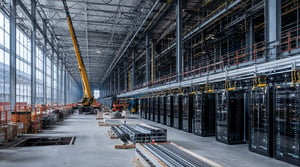
Atlanta is one of the fastest-growing data center markets in the country—at the geographic center of 124 data centers that are either planned or being built throughout Georgia, according to Cleanview, which tracks energy and data center infrastructure across the nation.
Nearly 4,000 megawatts of capacity are under construction right now across the metro area, according to The Real Deal newsletter—a level of activity that includes suburbs like Douglasville, Lithonia, Marietta and Hampton.
This is not an article about the data center boom. This is about the effect of that boom on all other kinds of construction across the region. Whether your next job is a multifamily development in Norcross, a commercial retrofit in Midtown or a warehouse in Conyers, the data center boom is shaping how that project gets done.
The Labor Squeeze
“Contractors are hitting a wall that has nothing to do with capital, permits or materials. They can’t find enough people,” states the blog of The Birmingham Group, a construction recruitment company. It adds that demand is especially high for project managers, estimators, superintendents, MEP coordinators, foremen and QA/QC professionals.
The local pipeline of industrial construction has more than doubled in the past year, according to real estate accounting firm Gallagher & Mohan. Many contractors in the Atlanta market now cite labor availability, not project demand, as their primary growth constraint for 2026. The people they need are already busy.
Across the country, this has meant a windfall for construction crews working on data centers. Fortune magazine reported in late 2025 that these workers were earning an average of 32% more than their counterparts on other types of projects.
In Atlanta, it’s not clear from available data if that has translated into rising wages for other types of projects. But the region’s construction labor shortage is severe enough that Atlanta’s public radio station, WABE, reported on it last year, noting that “76% percent of Georgia’s construction companies were struggling to find enough employees.”
The blog of The Agency Recruiting added, “For skilled trades professionals, this is the strongest labor market in a generation. The demand curve is steep and projected to last years.”
Equipment Delays
It’s been widely reported that the data center building boom has created such demand for large power transformers that the lead time is now three to five years. The supply chains that produce and deliver this equipment are largely the same as those that provide mechanical, electrical and plumbing (MEP) systems to other industrial, commercial and multifamily developments.
So the shortage of equipment for hyperscale data centers also shows up in the form of longer waits and higher prices for contractors who have nothing to do with AI infrastructure.
Land and Grid Pressure
Data center developers are paying significant premiums for sites in Metro Atlanta, raising land costs and competition for shovel-ready acreage in a region where the industrial pipeline was already running at a three-year high. The Atlanta Journal-Constitution cited an aging data center once used by Blackberry (the original smart phone) that sold for $63 million in 2022, and was sold again in January 2026 for $253 million.
Infrastructure that supports data centers—including new high-voltage lines and land easements—is also reshaping land use and driving up prices in some corridors around Atlanta.
The boom is putting enough pressure on local infrastructure and land markets that the policymakers are taking notice. The Georgia state legislature has been considering a moratorium on new data center projects, though no such rule had been implanted as of July 1, 2026. But at least 11 Georgia counties—including DeKalb, Clayton and Douglas—have all passed or proposed limitations on new data center projects. These actions are forward-looking and don’t affect projects already underway. Nor do they directly impact the construction community. But they do demonstrate how unsettled the regional picture remains.
The Upside
At a time when a number of development sectors are showing signs of slowing, the boom is keeping the region’s construction industry busy. Georgia Power has received approval to add 9,885 megawatts of new generation capacity; at $16.3 billion for construction, it’s one of the largest utility infrastructure investments in the country, according to ConstructConnect.
For Atlanta-area contractors, this creates a sustained pipeline of complex, high-value work that extends well beyond the data center campuses themselves: substations, transmission infrastructure, generation facilities. These are extended projects that represent years of procurement, construction and commissioning work.
These system upgrades are needed to serve new data center loads, and generally improve grid reliability for every other business on the same network. A more resilient grid is a better building environment for everyone.
Operating Inside a Structural Shift
Atlanta’s data center boom isn’t a temporary spike that will resolve once a few campuses go online. The investment cycle is long, the infrastructure requirements are deep and the downstream effects—on labor markets, equipment supply chains, land costs and grid capacity—are baked into the regional construction landscape for the foreseeable future.
Every builder in this metro is already operating inside those effects.
Best Supply provides construction materials, tools and supplies at competitive prices; delivers them on time; and shakes them out exactly where needed for a safe and efficient jobsite. See how we can help with your next project.