Production of Kentucky bourbon has more than doubled since 2010, according to the Distilled Spirits Council of the United States. Bourbon tourism has grown as well, accounting for 2.7 million visitors in 2025 — up 80% from 2019 figures.
The construction industry in and around Louisville has benefited from that growth. The Kentucky Distiller’s Association indicates that the industry is halfway through a 10-year investment cycle that has created a pipeline of projects that are generating, on average, $273 million a year in revenue to builders and contractors in the region.
In the Louisville metro area, bourbon construction is active at multiple scales and across multiple project types.
- Angel’s Envy completed an $8.2 million expansion of its 10-year-old Louisville distillery and brand home at 500 E. Main St., encompassing updated tasting rooms, event space and rooftop areas.
- Von Payne Spirits is converting the former Whiteside Bakery building at 1400 Broadway into a 60,000-square-foot distillery and tasting experience — a project that reflects how the industry’s growth intersects with adaptive reuse.
- In Elizabethtown, Whiskey House of Kentucky has partnered with The Koetter Group to build 12 new rickhouses over six years, each seven stories high with capacity for roughly 48,000 barrels.
These projects represent only the larger end of the spectrum. Fifteen years ago, Kentucky counted fewer than 20 licensed distilleries — almost all of them large operations. Today, according to tour company Bourbon Excursions, more than 100 craft distilleries are licensed in the state, with many having undertaken adaptive reuse and smaller-scale construction projects to accommodate production, warehousing and tourism.
Three Project Types
Bourbon construction falls into three categories, each with requirements that separate it from standard commercial or industrial work.
1. Production facilities, where fermentation, distillation and processing are done. Depending on the quantity of combustible spirits on premises, these structures are classified under the International Building Code as either F-1 (moderate hazard factory/industrial facility) or H-3 (high-hazard occupancy).
Once a project crosses into H-3 classification, the engineering requirements expand significantly to include explosion control, gas detection systems for flammable vapors, noncombustible containment floors and continuous high-flow mechanical ventilation with emergency backup power.
Electrical work in these environments must meet Class 1, Division 1 specifications for locations where flammable vapors may be present under normal operating conditions. This is a distinct specialty from standard commercial electrical and is not interchangeable with it.
Production facilities also carry a regulatory layer with no equivalent in most commercial work: the federal Alcohol and Tobacco Tax and Trade Bureau must approve a facility before production can begin, and federal requirements — bonded warehouse specifications, security provisions, recordkeeping facilities — are incorporated into the physical building design from the start.
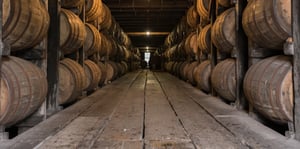
2. Barrel warehouses, or rickhouses, are purpose-built structures with no real parallel in other construction categories. Traditional rick-style storage and aging stacks barrels on wooden ricks of six to nine tiers high; a nine-tier structure requires ceiling heights in the range of 35 to 45 feet. The structural load from floor-to-ceiling barrels drives foundation and framing requirements that go well beyond standard warehouse design.
Climate control is a deliberate strategic variable rather than a comfort system: traditional Kentucky rickhouses are unheated and uncooled by design. They use seasonal temperature swings to drive the chemical reactions that develop flavor. The building envelope is engineered to allow those swings — which means it’s intentionally different from most industrial construction, which seeks to minimize indoor changes in temperature and humidity. Fire protection requirements for high-piled barrel storage add further complexity, with Kentucky having adopted standards specific to rickhouse construction covering loads, materials, egress and suppression systems.
3. Visitor centers and tasting rooms are the piece of bourbon construction most familiar to commercial contractors. The work resembles hospitality or retail tenant improvement more than industrial construction. The complicating factor is adjacency: Visitor-facing spaces on bourbon campuses typically share a building or campus with production and storage areas that carry H-3 occupancy requirements.
When a structure contains multiple occupancy types, each portion is individually classified, . Managing the interface between a guest hospitality space and a hazardous industrial occupancy — fire-rated separations, egress requirements, ventilation boundaries — requires close coordination among architect, fire marshal and contractor from the earliest stages of design.
Growth During Good Times and Hard Times Alike
The bourbon industry’s construction activity in Louisville is steady, long-cycle and expanding. Distilleries add production capacity as sales grow, build visitor infrastructure as tourism increases and add rickhouses as barrel inventory grows. None of that is transactional — these are multi-decade business commitments, and the construction follows accordingly.
And even with the bourbon industry struggling in 2026 from a combination of overproduction, global trade disputes and competition from other spirits, the tourism it attracts has fostered a billion dollars’ worth of hospitality construction projects, including:
-
The 168-room Hotel Bourre Bonne opened in April 2025 on Whiskey Row following $75 million in construction.
-
Groundbreaking is expected in 2027 on the $600 million+ conversion of the former Humana Corp. headquarters in downtown Louisville to a 1,000-room hotel.
- Developers are actively pursuing a $185 million conversion of the downtown Fifth Third Bank building to a 420-room JW Mariott hotel.
Without the bourbon industry, the construction business in and around Louisville would be noticeably smaller and less well off.
Are you sourcing materials for your next project? Best Supply offers technical expertise, reliable delivery, white glove shakeout and competitive pricing on everything you need to keep your next project on time and on budget. Request a quote here.