
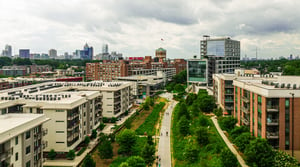
The Atlanta BeltLine is inching toward completion of the 22-mile loop of multiuse trail — a milestone 20 years in the making. And the construction activity it’s generating is spreading well beyond the trail itself.
The Atlanta BeltLine is an old railroad corridor around the city's urban core that is being converted into a network of trails, transit connections, parks and adjacent mixed-use development. Scheduled for completion in 2030, it’s intended to create economic and recreational opportunities in the neighborhoods it touches.
From Reynoldstown to Oakland City to West End, Atlanta Beltline Inc. indicates infill development is accelerating along every completed trail segment, with a new wave of projects breaking as the Southside Trail approaches opening. It’s been credited with creating 45,000 construction jobs.
For Atlanta-area contractors, the BeltLine represents a long-term pipeline of infill construction in dense, established neighborhoods — work that raises a number of challenges that don’t exist in suburban greenfields or large-scale urban construction projects.
Knowing where that pipeline is active, what it’s producing and what it demands of builders is relevant when competing for work in Atlanta proper.
Generating Private Development
So far, development of the Beltline has attracted more than $9 billion of private investment for about 50 projects adjacent to the trail, according to Perkins & Will, an architecture/design firm that has played a major role in the BeltLine’s development.
The Eastside Trail, which opened to the public in 2012, was the first segment to be completed, and has attracted $638 million in private development adjacent to its 2.25 miles, Perkins & Will notes. Now in a mature state of development, this section is still sparking projects that include infill housing and adaptive reuse of former industrial buildings in neighborhoods like Inman Park, Reynoldstown and the Old Fourth Ward, according to the website Urbanize.
The Westside and Southwest trails are currently the most active zones for construction of the BeltLine itself, and they are fostering private investment as well.
The $77 million 840 Woodrow mixed-use project, which includes 300+ housing units, is taking shape on roughly seven acres in Oakland City adjacent to the Westside Trail. Other projects include the 16,000 square-foot Oakland Exchange, creative and retail adaptation of the century-old Cut Rate Box warehouse complex and the GW Parkside luxury townhome development at Gordon White Park.
Murphy Crossing, a 20-acre site owned by Atlanta BeltLine Inc., is subject of a new master plan calling for 625 residential units, 82,000 square feet of commercial space and 103,000 square feet of light industrial uses. Groundbreaking on the five-phase project is expected this year.
Along the Southside Trail, Atlanta BeltLine Inc. is working to open remaining trail segments by mid-year, which is expected to trigger the next wave of development in Pittsburgh, Summerhill and Ormewood Park.
Challenges of Building on the BeltLine
Infill projects adjacent to the BeltLine typically sit on former industrial parcels surrounded by active streets, existing residences and, in many cases, the trail itself — which carries pedestrian and cyclist traffic throughout construction. The logistics challenge is constant.
Staging areas are minimal or nonexistent, and material deliveries must be timed precisely, stored efficiently and moved quickly. The logistics pressures that affect all intown Atlanta infill (see related blog post: In Atlanta’s Tight Urban Jobsites, Logistics Make or Break the Schedule) apply here with full force. For contractors accustomed to suburban work with generous laydown areas, the adjustment is significant and needs to be priced into any bid before it goes out.
Further, brownfield conditions are the rule, not the exception. Most BeltLine-adjacent parcels were formerly industrial. Environmental unknowns are common, including things like contaminated soils, buried infrastructure and unpredictable fill conditions.
Any of these can affect grading, foundation design and scheduling in ways that aren’t visible at bid time. The 840 Woodrow site alone required an estimated $1.5 million in brownfield remediation before redevelopment could begin, according to the Saporta Report.
Contractors pursuing this work should build meaningful contingency into their bids and establish a clear protocol for handling changed conditions before they appear in the field.
Adaptive reuse adds layers of complexity that new construction doesn’t carry. Many of the most active BeltLine-adjacent projects involve converting former warehouses, industrial buildings and older commercial stock. That means unknown conditions: structural systems that differ from what drawings show, MEP infrastructure that must be selectively retained or removed and envelope systems requiring careful integration with new construction.
Sequencing is more complex than a ground-up build and demands earlier collaboration among the GC, architect and structural engineer. Projects involving historic tax credits come with additional documentation requirements and materials approval processes governed by the National Park Service.
These are unfamiliar obligations for contractors without preservation experience, and they carry schedule risk if not understood at the outset.
Community expectations also add a compliance dimension that most commercial projects don’t carry. BeltLine corridors run through actively occupied neighborhoods where noise, dust, traffic disruption and visual impact are closely watched by residents.
Beyond standard permitting, many projects involve coordination with Atlanta BeltLine Inc. directly — particularly where construction affects trail access or future trail segments. Projects funded through the BeltLine Tax Allocation District carry affordability requirements and development standards that add a compliance layer on top of standard commercial work.
Contractors who treat these projects like standard commercial infill without accounting for the community and institutional relationships involved tend to encounter friction that affects schedules and margins.
4 Recommendations for BeltLine Builders
- Assume brownfield conditions on any former industrial site and budget time and contingency accordingly; unknown environmental conditions are the most common source of cost overruns on BeltLine-adjacent projects.
- Plan logistics as carefully as structure. On a constrained urban infill site adjacent to an active trail, material delivery, waste removal and equipment access require the same deliberate planning as the construction sequence itself.
- Build relationships with BeltLine-familiar developers early — the same development teams are active across multiple projects in the corridor, and repeat relationships matter more here than in most Atlanta submarkets.
- Get familiar with historic tax credit requirements if you aren’t already. An increasing share of BeltLine-adjacent adaptive reuse work involves preservation financing that adds documentation and compliance obligations the GC must manage from the outset.
When the Southside Trail opens, it won’t just connect the east and west sides of Atlanta. It will activate the next wave of development pressure in neighborhoods that have been waiting for years.
For contractors who understand the environment, that pipeline represents durable intown opportunity in a market where suburban greenfield volume is moderating and momentum has clearly shifted inside the perimeter.
Best Supply offers delivery service that’s tailor-made for the needs of contractors working on urban infill — on-time arrival with drivers who are empowered to make decisions on their own so builders and contractors get the right materials when and where they’re needed. Let us quote your next project or answer your questions by clicking here.